A new campaign is making use of Cloudflare Tunnel subdomains to host malicious payloads and deliver them via malicious attachments embedded in phishing emails.
The ongoing campaign has been codenamed SERPENTINE#CLOUD by Securonix.
It leverages “the Cloudflare Tunnel infrastructure and Python-based loaders to deliver memory-injected payloads through a chain of shortcut files and obfuscated scripts,” security researcher Tim Peck said in a report shared with The Hacker News.
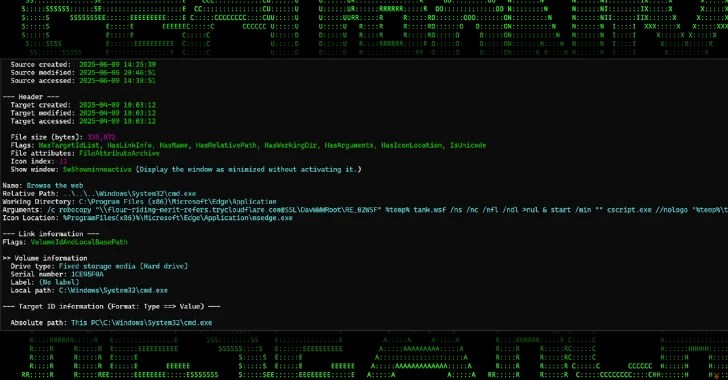
The attack starts with sending payment- or invoice-themed phishing emails bearing a link to a zipped document that contains a Windows shortcut (LNK) file. These shortcuts are disguised as documents to trick victims into opening them, effectively activating the infection sequence.
The elaborate multi-step process culminates in the execution of a Python-based shellcode loader that executes payloads packed with the open-source Donut loader entirely in memory.
Securonix said the campaign has targeted the United States, United Kingdom, Germany, and other regions across Europe and Asia. The identity of the threat actor(s) behind the campaign is presently unknown, although the cybersecurity company pointed out their English fluency.
The threat activity cluster is also notable for its shifting initial access methods, pivoting from internet shortcut (URL) files to using LNK shortcut files masquerading as PDF documents. These payloads are then used to retrieve additional stages over WebDAV via the Cloudflare Tunnel subdomains.
It’s worth noting that a variation of this campaign was previously documented by eSentire and Proofpoint last year, with the attacks paving the way for AsyncRAT, GuLoader, PureLogs Stealer, Remcos RAT, Venom RAT, and XWorm.

The abuse of TryCloudflare offers manifold advantages. For starters, malicious actors have long made it harder to detect by using legitimate cloud service providers as a front for their operations, including payload delivery and command-and-control (C2) communication.
By using a reputable subdomain (“*.trycloudflare[.]com”) for nefarious ends, it makes it exceedingly tough for defenders to distinguish between harmful and benign activities, thereby allowing it to evade URL or domain-based blocking mechanisms.
The initial infection occurs when the LNK files are launched, causing it to download a next-stage payload, a Windows Script File (WSF), from a remote WebDAV share hosted on a Cloudflare Tunnel subdomain. The WSF file is subsequently executed using cscript.exe in a manner without arousing the victim’s suspicion.

“This WSF file functions as a lightweight VBScript-based loader, designed to execute an external batch file from a second Cloudflare domain,” Peck said. “The ‘kiki.bat’ file serves as the main payload delivery script next in the series of stagers. Overall, it’s designed for stealth and persistence.”
The primary responsibility of the batch script is to display a decoy PDF document, check for antivirus software, and download and execute Python payloads, which are then used to run Donut-packed payloads like AsyncRAT or Revenge RAT in memory.
Securonix said there is a possibility that the script may have been vibe-coded using a large language model owing to the presence of well-defined comments in the source code.
“The SERPENTINE#CLOUD campaign is a complex and layered infection chain that blends a bit of social engineering, living-off-the-land techniques, and evasive in-memory code execution,” the company concluded. “The abuse of Cloudflare Tunnel infrastructure further complicates network visibility by giving the actor a disposable and encrypted transport layer for staging malicious files without maintaining traditional infrastructure.”
Shadow Vector Targets Colombian Users via SVG Smuggling
The disclosure comes as Acronis identified an active malware campaign dubbed Shadow Vector targeting users in Colombia using booby-trapped scalable vector graphics (SVG) files as the malware delivery vector in phishing emails that impersonate court notifications.
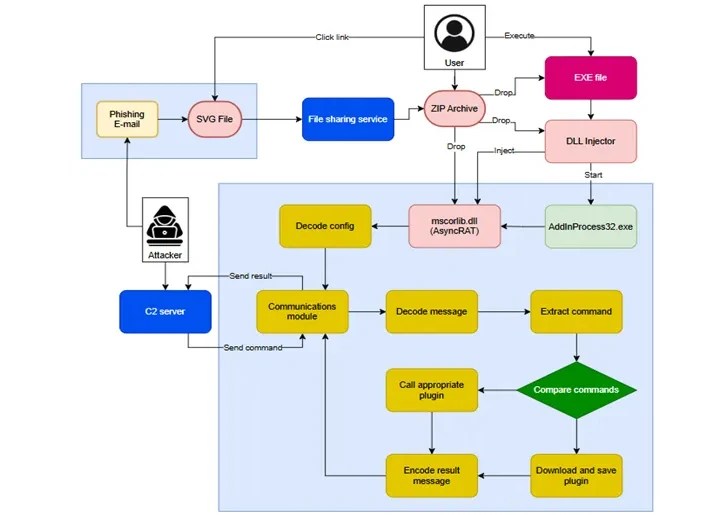
“Attackers distributed spear-phishing emails impersonating trusted institutions in Colombia, delivering SVG decoys with embedded links to JS / VBS stagers hosted on public platforms, or password-protected ZIP files containing the payloads directly,” Acronis researchers Santiago Pontiroli, Jozsef Gegeny, and Ilia Dafchev said.
The attacks led to the deployment of remote access trojans like AsyncRAT and Remcos RAT, with recent campaigns also utilizing a .NET loader associated with Katz Stealer. These attack chains involve hiding the payloads within Base64-encoded text of image files hosted on the Internet Archive.
A noteworthy aspect of the campaign is the use of SVG smuggling techniques to deliver malicious ZIP archives using SVG files. These payloads are hosted on file-sharing services such as Bitbucket, Dropbox, Discord, and YDRAY. The download archives contain both legitimate executables and malicious DLLs, the latter of which are sideloaded to ultimately serve the trojans.

“A natural evolution from its earlier SVG smuggling techniques, this threat actor has adopted a modular, memory-resident loader that can execute payloads dynamically and entirely in memory, leaving minimal traces behind,” the researchers said.
“The presence of Portuguese-language strings and method parameters within the loader mirrors TTPs commonly observed in Brazilian banking malware, suggesting potential code reuse, shared development resources or even cross-regional actor collaboration.”
ClickFix Surge Propels Drive-By Compromises
The findings also coincide with a rise in social engineering attacks that employ the ClickFix tactic to deploy stealers and remote access trojans like Lumma Stealer and SectopRAT under the guise of fixing an issue or completing a CAPTCHA verification.
According to statistics shared by ReliaQuest, drive-by compromises accounted for 23% of all phishing-based tactics observed between March and May 2025. “Techniques like ClickFix were central to drive-by downloads,” the cybersecurity company said.
ClickFix is effective primarily because it deceives targets into carrying out seemingly harmless, everyday actions that are unlikely to raise any red flags, because they’re so used to seeing CAPTCHA screening pages and other notifications. What makes it compelling is that it gets users to do the main work of infecting their own machines instead of having to resort to more sophisticated methods like exploiting software flaws.
“External remote resources dropped from third to fourth place as attackers increasingly exploit user mistakes rather than technical vulnerabilities,” ReliaQuest said. “This shift is likely driven by the simplicity, success rate, and universal applicability of social engineering campaigns like ClickFix.”
About The Author

Original post here


