Skip to content

Secure IT

Stay Secure. Stay Informed.

Primary Menu
  • Home
  • Sources
    • Krebs On Security
    • Security Week
    • The Hacker News
    • Schneier On Security
  • Home
  • The Hacker News
  • Critical Golden dMSA Attack in Windows Server 2025 Enables Cross-Domain Attacks and Persistent Access
  • The Hacker News

Critical Golden dMSA Attack in Windows Server 2025 Enables Cross-Domain Attacks and Persistent Access

[email protected] The Hacker News Published: July 16, 2025 | Updated: July 16, 2025 4 min read
0 views

Jul 16, 2025Ravie LakshmananWindows Server / Enterprise Security

Critical dMSA Flaw in Windows Server 2025

Cybersecurity researchers have disclosed what they say is a “critical design flaw” in delegated Managed Service Accounts (dMSAs) introduced in Windows Server 2025.

“The flaw can result in high-impact attacks, enabling cross-domain lateral movement and persistent access to all managed service accounts and their resources across Active Directory indefinitely,” Semperis said in a report shared with The Hacker News.

Put differently, successful exploitation could allow adversaries to sidestep authentication guardrails and generate passwords for all Delegated Managed Service Accounts (dMSAs) and group Managed Service Accounts (gMSAs) and their associated service accounts.

The persistence and privilege escalation method has been codenamed Golden dMSA, with the cybersecurity company deeming it as low complexity owing to the fact that the vulnerability simplifies brute-force password generation.

However, in order for bad actors to exploit it, they must already be in possession of a Key Distribution Service (KDS) root key that’s typically only available to privileged accounts, such as root Domain Admins, Enterprise Admins, and SYSTEM.

Cybersecurity

Described as the crown jewel of Microsoft’s gMSA infrastructure, the KDS root key serves as a master key, allowing an attacker to derive the current password for any dMSA or gMSA account without having to connect to the domain controller.

“The attack leverages a critical design flaw: A structure that’s used for the password-generation computation contains predictable time-based components with only 1,024 possible combinations, making brute-force password generation computationally trivial,” security researcher Adi Malyanker said.

Delegated Managed Service Accounts is a new feature introduced by Microsoft that facilitates migration from an existing legacy service account. It was introduced in Windows Server 2025 as a way to counter Kerberoasting attacks.
The machine accounts bind authentication directly to explicitly authorized machines in Active Directory (AD), thus eliminating the possibility of credential theft. By tying authentication to device identity, only specified machine identities mapped in AD can access the account.

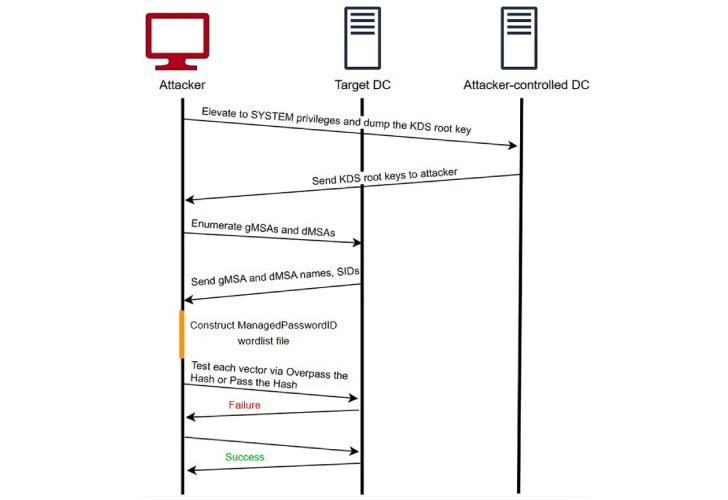
Golden dMSA, similar to Golden gMSA Active Directory attacks, plays out over four steps once an attacker has obtained elevated privileges within a domain –

  • Extracting KDS root key material by elevating to SYSTEM privileges on one of the domain controllers
  • Enumerating dMSA accounts using LsaOpenPolicy and LsaLookupSids APIs or via a Lightweight Directory Access Protocol (LDAP)-based approach
  • Identifying the ManagedPasswordID attribute and password hashes through targeted guessing
  • Generating valid passwords (i.e., Kerberos tickets) for any gMSA or dMSA associated with the compromised key and testing them via Pass the Hash or Overpass the Hash techniques

“This process requires no additional privileged access once the KDS root key is obtained, making it a particularly dangerous persistence method,” Malyanker said.

“The attack highlights the critical trust boundary of managed service accounts. They rely on domain-level cryptographic keys for security. Although automatic password rotation provides excellent protection against typical credential attacks, Domain Admins, DnsAdmins, and Print Operators can bypass these protections entirely and compromise all of the dMSAs and gMSAs in the forest.”

Semperis noted that the Golden dMSA technique turns the breach into a forest-wide persistent backdoor, given that compromising the KDS root key from any single domain within the forest is enough to breach every dMSA account across all domains in that forest.

Cybersecurity

In other words, a single KDS root key extraction can be weaponized to achieve cross-domain account compromise, forest-wide credential harvesting, and lateral movement across domains using the compromised dMSA accounts.

“Even in environments with multiple KDS root keys, the system consistently uses the first (oldest) KDS root key for compatibility reasons,” Malyanker pointed out. “This means that the original key we’ve compromised could be preserved by Microsoft’s design – creating a persistent backdoor that could last for years.”

Even more concerning is that the attack completely sidesteps normal Credential Guard protections, which are used to secure NTLM password hashes, Kerberos Ticket Granting Tickets (TGTs), and credentials so that only privileged system software can access them.

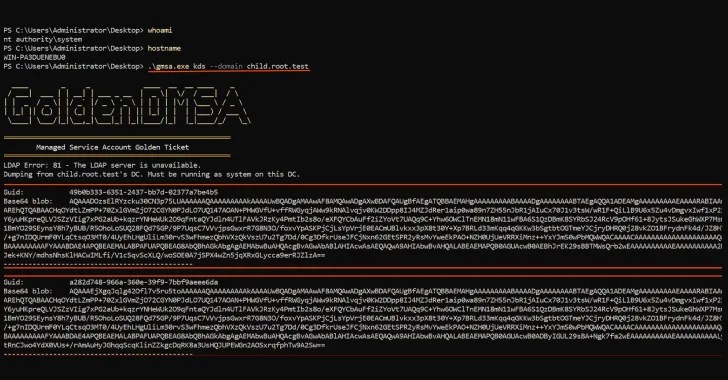
Following responsible disclosure on May 27, 2025, Microsoft said, “If you have the secrets used to derive the key, you can authenticate as that user. These features have never been intended to protect against a compromise of a domain controller.” Semperis has also released an open-source as proof-of-concept (PoC) to demonstrate the attack.

“What starts as one DC compromise escalates to owning every dMSA-protected service across an entire enterprise forest,” Malyanker said. “It’s not just privilege escalation. It’s enterprise-wide digital domination through a single cryptographic vulnerability.”

Found this article interesting? Follow us on Twitter  and LinkedIn to read more exclusive content we post.

About The Author

[email protected] The Hacker News

See author's posts

Original post here

What do you feel about this?

  • The Hacker News

Post navigation

Previous: AI Agents Act Like Employees With Root Access—Here’s How to Regain Control
Next: UNC6148 Backdoors Fully-Patched SonicWall SMA 100 Series Devices with OVERSTEP Rootkit

Author's Other Posts

Attackers Hijack MikroTik Routers Through Internet-Exposed SSH Without Authentication micro.jpg

Attackers Hijack MikroTik Routers Through Internet-Exposed SSH Without Authentication

September 6, 2026 0 0
Four REVSTEALER-Linked Modules Disable Windows Update and Defender to Run a Crypto Miner rev.jpg

Four REVSTEALER-Linked Modules Disable Windows Update and Defender to Run a Crypto Miner

September 6, 2026 0 0
Unpatched Magento and Adobe Commerce Zero-Day Exploited to Backdoor Online Stores adobe-exploit.jpg

Unpatched Magento and Adobe Commerce Zero-Day Exploited to Backdoor Online Stores

September 5, 2026 0 0
Attackers Breached JetBrains Cadence via Unpatched TeamCity, Extracting AWS Credentials jet.jpg

Attackers Breached JetBrains Cadence via Unpatched TeamCity, Extracting AWS Credentials

September 5, 2026 0 0

Related Stories

micro.jpg
  • The Hacker News

Attackers Hijack MikroTik Routers Through Internet-Exposed SSH Without Authentication

[email protected] The Hacker News September 6, 2026 0 0
rev.jpg
  • The Hacker News

Four REVSTEALER-Linked Modules Disable Windows Update and Defender to Run a Crypto Miner

[email protected] The Hacker News September 6, 2026 0 0
adobe-exploit.jpg
  • The Hacker News

Unpatched Magento and Adobe Commerce Zero-Day Exploited to Backdoor Online Stores

[email protected] The Hacker News September 5, 2026 0 0
jet.jpg
  • The Hacker News

Attackers Breached JetBrains Cadence via Unpatched TeamCity, Extracting AWS Credentials

[email protected] The Hacker News September 5, 2026 0 0
vmware-host.jpg
  • The Hacker News

Critical VMware Workstation and Fusion Flaw Lets VM Admins Execute Host Code

[email protected] The Hacker News September 5, 2026 0 0
trezor.jpg
  • The Hacker News

Trezor Says ShipMonk Breach Exposed 67,000 U.S. Customers’ Data It Said Was Deleted

[email protected] The Hacker News September 5, 2026 0 0

Trending Now

Attackers Hijack MikroTik Routers Through Internet-Exposed SSH Without Authentication micro.jpg 1

Attackers Hijack MikroTik Routers Through Internet-Exposed SSH Without Authentication

September 6, 2026 0 0
Four REVSTEALER-Linked Modules Disable Windows Update and Defender to Run a Crypto Miner rev.jpg 2

Four REVSTEALER-Linked Modules Disable Windows Update and Defender to Run a Crypto Miner

September 6, 2026 0 0
Unpatched Magento and Adobe Commerce Zero-Day Exploited to Backdoor Online Stores adobe-exploit.jpg 3

Unpatched Magento and Adobe Commerce Zero-Day Exploited to Backdoor Online Stores

September 5, 2026 0 0
Attackers Breached JetBrains Cadence via Unpatched TeamCity, Extracting AWS Credentials jet.jpg 4

Attackers Breached JetBrains Cadence via Unpatched TeamCity, Extracting AWS Credentials

September 5, 2026 0 0

Connect with Us

Social menu is not set. You need to create menu and assign it to Social Menu on Menu Settings.

Trending News

Attackers Hijack MikroTik Routers Through Internet-Exposed SSH Without Authentication micro.jpg 1
  • The Hacker News

Attackers Hijack MikroTik Routers Through Internet-Exposed SSH Without Authentication

September 6, 2026 0 0
Four REVSTEALER-Linked Modules Disable Windows Update and Defender to Run a Crypto Miner rev.jpg 2
  • The Hacker News

Four REVSTEALER-Linked Modules Disable Windows Update and Defender to Run a Crypto Miner

September 6, 2026 0 0
Unpatched Magento and Adobe Commerce Zero-Day Exploited to Backdoor Online Stores adobe-exploit.jpg 3
  • The Hacker News

Unpatched Magento and Adobe Commerce Zero-Day Exploited to Backdoor Online Stores

September 5, 2026 0 0
Attackers Breached JetBrains Cadence via Unpatched TeamCity, Extracting AWS Credentials jet.jpg 4
  • The Hacker News

Attackers Breached JetBrains Cadence via Unpatched TeamCity, Extracting AWS Credentials

September 5, 2026 0 0
Critical VMware Workstation and Fusion Flaw Lets VM Admins Execute Host Code vmware-host.jpg 5
  • The Hacker News

Critical VMware Workstation and Fusion Flaw Lets VM Admins Execute Host Code

September 5, 2026 0 0
Trezor Says ShipMonk Breach Exposed 67,000 U.S. Customers’ Data It Said Was Deleted trezor.jpg 6
  • The Hacker News

Trezor Says ShipMonk Breach Exposed 67,000 U.S. Customers’ Data It Said Was Deleted

September 5, 2026 0 0
Thousands of OpenAI Agents Quietly Turned an Abandoned Wiki Into Their Coordination Channel agents-openai.jpg 7
  • The Hacker News

Thousands of OpenAI Agents Quietly Turned an Abandoned Wiki Into Their Coordination Channel

September 5, 2026 0 0

You may have missed

micro.jpg
  • The Hacker News

Attackers Hijack MikroTik Routers Through Internet-Exposed SSH Without Authentication

[email protected] The Hacker News September 6, 2026 0 0
rev.jpg
  • The Hacker News

Four REVSTEALER-Linked Modules Disable Windows Update and Defender to Run a Crypto Miner

[email protected] The Hacker News September 6, 2026 0 0
adobe-exploit.jpg
  • The Hacker News

Unpatched Magento and Adobe Commerce Zero-Day Exploited to Backdoor Online Stores

[email protected] The Hacker News September 5, 2026 0 0
jet.jpg
  • The Hacker News

Attackers Breached JetBrains Cadence via Unpatched TeamCity, Extracting AWS Credentials

[email protected] The Hacker News September 5, 2026 0 0
Copyright © 2026 All rights reserved. | MoreNews by AF themes.