Skip to content

Secure IT

Stay Secure. Stay Informed.

Primary Menu
  • Home
  • Sources
    • Krebs On Security
    • Security Week
    • The Hacker News
    • Schneier On Security
  • Home
  • The Hacker News
  • Hackers Exploit WordPress mu-Plugins to Inject Spam and Hijack Site Images
  • The Hacker News

Hackers Exploit WordPress mu-Plugins to Inject Spam and Hijack Site Images

[email protected] The Hacker News Published: March 31, 2025 | Updated: March 31, 2025 3 min read
0 views

Mar 31, 2025Ravie LakshmananData Theft / Website Security

Hackers Exploit WordPress

Threat actors are using the “mu-plugins” directory in WordPress sites to conceal malicious code with the goal of maintaining persistent remote access and redirecting site visitors to bogus sites.

mu-plugins, short for must-use plugins, refers to plugins in a special directory (“wp-content/mu-plugins”) that are automatically executed by WordPress without the need to enable them explicitly via the admin dashboard. This also makes the directory an ideal location for staging malware.

“This approach represents a concerning trend, as the mu-plugins (Must-Use plugins) are not listed in the standard WordPress plugin interface, making them less noticeable and easier for users to ignore during routine security checks,” Sucuri researcher Puja Srivastava said in an analysis.

Cybersecurity

In the incidents analyzed by the website security company, three different kinds of rogue PHP code have been discovered in the directory –

  • “wp-content/mu-plugins/redirect.php,” which redirects site visitors to an external malicious website
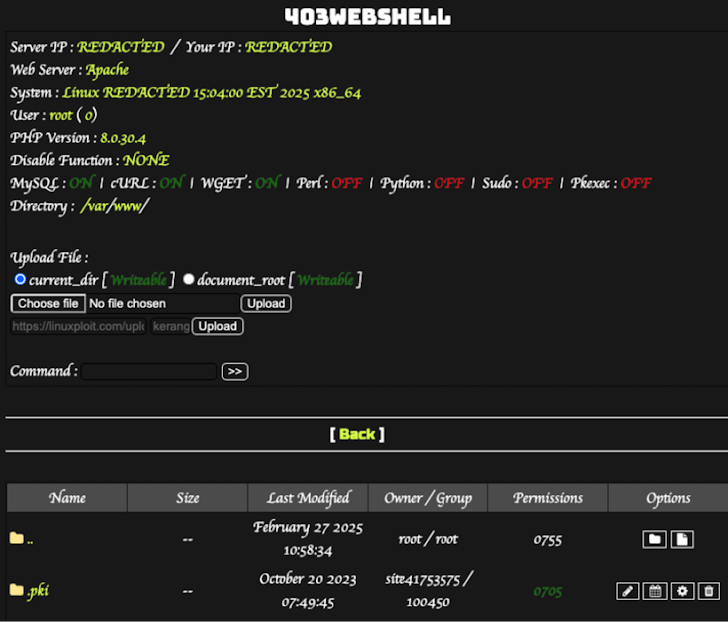
  • “wp-content/mu-plugins/index.php,” which offers web shell-like functionality, letting attackers execute arbitrary code by downloading a remote PHP script hosted on GitHub
  • “wp-content/mu-plugins/custom-js-loader.php,” which injects unwanted spam onto the infected website, likely with an intent to promote scams or manipulate SEO rankings, by replacing all images on the site with explicit content and hijacking outbound links to malicious sites

The “redirect.php,” Sucuri said, masquerades as a web browser update to deceive victims into installing malware that can steal data or drop additional payloads.

“The script includes a function that identifies whether the current visitor is a bot,” Srivastava explained. “This allows the script to exclude search engine crawlers and prevent them from detecting the redirection behavior.”

The development comes as threat actors are continuing to use infected WordPress sites as staging grounds to trick website visitors into running malicious PowerShell commands on their Windows computers under the guise of a Google reCAPTCHA or Cloudflare CAPTCHA verification – a prevalent tactic called ClickFix – and deliver the Lumma Stealer malware.
Hackers Exploit WordPress

Hacked WordPress sites are also being used to deploy malicious JavaScript that can redirect visitors to unwanted third-party domains or act as a skimmer to siphon financial information entered on checkout pages.

It’s currently not known how the sites may have been breached, but the usual suspects are vulnerable plugins or themes, compromised admin credentials, and server misconfigurations.

Cybersecurity

According to a new report from Patchstack, threat actors have routinely exploited four different security vulnerabilities since the start of the year –

  • CVE-2024-27956 (CVSS score: 9.9) – An unauthenticated arbitrary SQL execution vulnerability in WordPress Automatic Plugin – AI content generator and auto poster plugin
  • CVE- 2024-25600 (CVSS score: 10.0) – An unauthenticated remote code execution vulnerability in Bricks theme
  • CVE-2024-8353 (CVSS score: 10.0) – An unauthenticated PHP object injection to remote code execution vulnerability in GiveWP plugin
  • CVE-2024-4345 (CVSS score: 10.0) – An unauthenticated arbitrary file upload vulnerability in Startklar Elementor Addons for WordPress

To mitigate the risks posed by these threats, it’s essential that WordPress site owners keep plugins and themes up to date, routinely audit code for the presence of malware, enforce strong passwords, and deploy a web application firewall to malicious requests and prevent code injections.

Found this article interesting? Follow us on Twitter  and LinkedIn to read more exclusive content we post.

About The Author

[email protected] The Hacker News

See author's posts

Original post here

What do you feel about this?

  • The Hacker News

Post navigation

Previous: Part of EU’s New €1.3 Billion Investment Going to Cybersecurity
Next: Hacker Leaks Samsung Customer Data

Author's Other Posts

India Orders Messaging Apps to Work Only With Active SIM Cards to Prevent Fraud and Misuse whatsapp-sim.jpg

India Orders Messaging Apps to Work Only With Active SIM Cards to Prevent Fraud and Misuse

December 2, 2025 0 0
Researchers Capture Lazarus APT’s Remote-Worker Scheme Live on Camera korean.jpg

Researchers Capture Lazarus APT’s Remote-Worker Scheme Live on Camera

December 2, 2025 0 1
GlassWorm Returns with 24 Malicious Extensions Impersonating Popular Developer Tools hacked.jpg

GlassWorm Returns with 24 Malicious Extensions Impersonating Popular Developer Tools

December 2, 2025 0 0
Malicious npm Package Uses Hidden Prompt and Script to Evade AI Security Tools npm-mal.jpg

Malicious npm Package Uses Hidden Prompt and Script to Evade AI Security Tools

December 2, 2025 0 1

Related Stories

whatsapp-sim.jpg
  • The Hacker News

India Orders Messaging Apps to Work Only With Active SIM Cards to Prevent Fraud and Misuse

[email protected] The Hacker News December 2, 2025 0 0
korean.jpg
  • The Hacker News

Researchers Capture Lazarus APT’s Remote-Worker Scheme Live on Camera

[email protected] The Hacker News December 2, 2025 0 1
hacked.jpg
  • The Hacker News

GlassWorm Returns with 24 Malicious Extensions Impersonating Popular Developer Tools

[email protected] The Hacker News December 2, 2025 0 0
npm-mal.jpg
  • The Hacker News

Malicious npm Package Uses Hidden Prompt and Script to Evade AI Security Tools

[email protected] The Hacker News December 2, 2025 0 1
iran-hacking.jpg
  • The Hacker News

Iran-Linked Hackers Hits Israeli Sectors with New MuddyViper Backdoor in Targeted Attacks

[email protected] The Hacker News December 2, 2025 0 0
SecAlerts.jpg
  • The Hacker News

SecAlerts Cuts Through the Noise with a Smarter, Faster Way to Track Vulnerabilities

[email protected] The Hacker News December 2, 2025 0 0

Trending Now

Drones to Diplomas: How Russia’s Largest Private University is Linked to a $25M Essay Mill Drones to Diplomas: How Russia’s Largest Private University is Linked to a $25M Essay Mill 1

Drones to Diplomas: How Russia’s Largest Private University is Linked to a $25M Essay Mill

December 6, 2025 0 0
SMS Phishers Pivot to Points, Taxes, Fake Retailers SMS Phishers Pivot to Points, Taxes, Fake Retailers 2

SMS Phishers Pivot to Points, Taxes, Fake Retailers

December 4, 2025 0 0
India Orders Messaging Apps to Work Only With Active SIM Cards to Prevent Fraud and Misuse whatsapp-sim.jpg 3

India Orders Messaging Apps to Work Only With Active SIM Cards to Prevent Fraud and Misuse

December 2, 2025 0 0
Researchers Capture Lazarus APT’s Remote-Worker Scheme Live on Camera korean.jpg 4

Researchers Capture Lazarus APT’s Remote-Worker Scheme Live on Camera

December 2, 2025 0 1

Connect with Us

Social menu is not set. You need to create menu and assign it to Social Menu on Menu Settings.

Trending News

Drones to Diplomas: How Russia’s Largest Private University is Linked to a $25M Essay Mill Drones to Diplomas: How Russia’s Largest Private University is Linked to a $25M Essay Mill 1
  • Uncategorized

Drones to Diplomas: How Russia’s Largest Private University is Linked to a $25M Essay Mill

December 6, 2025 0 0
SMS Phishers Pivot to Points, Taxes, Fake Retailers SMS Phishers Pivot to Points, Taxes, Fake Retailers 2
  • Uncategorized

SMS Phishers Pivot to Points, Taxes, Fake Retailers

December 4, 2025 0 0
India Orders Messaging Apps to Work Only With Active SIM Cards to Prevent Fraud and Misuse whatsapp-sim.jpg 3
  • The Hacker News

India Orders Messaging Apps to Work Only With Active SIM Cards to Prevent Fraud and Misuse

December 2, 2025 0 0
Researchers Capture Lazarus APT’s Remote-Worker Scheme Live on Camera korean.jpg 4
  • The Hacker News

Researchers Capture Lazarus APT’s Remote-Worker Scheme Live on Camera

December 2, 2025 0 1
GlassWorm Returns with 24 Malicious Extensions Impersonating Popular Developer Tools hacked.jpg 5
  • The Hacker News

GlassWorm Returns with 24 Malicious Extensions Impersonating Popular Developer Tools

December 2, 2025 0 0
Malicious npm Package Uses Hidden Prompt and Script to Evade AI Security Tools npm-mal.jpg 6
  • The Hacker News

Malicious npm Package Uses Hidden Prompt and Script to Evade AI Security Tools

December 2, 2025 0 1
Iran-Linked Hackers Hits Israeli Sectors with New MuddyViper Backdoor in Targeted Attacks iran-hacking.jpg 7
  • The Hacker News

Iran-Linked Hackers Hits Israeli Sectors with New MuddyViper Backdoor in Targeted Attacks

December 2, 2025 0 0

You may have missed

Drones to Diplomas: How Russia’s Largest Private University is Linked to a $25M Essay Mill
  • Uncategorized

Drones to Diplomas: How Russia’s Largest Private University is Linked to a $25M Essay Mill

Sean December 6, 2025 0 0
SMS Phishers Pivot to Points, Taxes, Fake Retailers
  • Uncategorized

SMS Phishers Pivot to Points, Taxes, Fake Retailers

Sean December 4, 2025 0 0
whatsapp-sim.jpg
  • The Hacker News

India Orders Messaging Apps to Work Only With Active SIM Cards to Prevent Fraud and Misuse

[email protected] The Hacker News December 2, 2025 0 0
korean.jpg
  • The Hacker News

Researchers Capture Lazarus APT’s Remote-Worker Scheme Live on Camera

[email protected] The Hacker News December 2, 2025 0 1
Copyright © 2026 All rights reserved. | MoreNews by AF themes.