Skip to content

Secure IT

Stay Secure. Stay Informed.

Primary Menu
  • Home
  • Sources
    • Krebs On Security
    • Security Week
    • The Hacker News
    • Schneier On Security
  • Home
  • The Hacker News
  • Researchers Detail Windows EPM Poisoning Exploit Chain Leading to Domain Privilege Escalation
  • The Hacker News

Researchers Detail Windows EPM Poisoning Exploit Chain Leading to Domain Privilege Escalation

[email protected] The Hacker News Published: August 10, 2025 | Updated: August 10, 2025 4 min read
0 views

Aug 10, 2025Ravie LakshmananVulnerability / Endpoint Security

Cybersecurity researchers have presented new findings related to a now-patched security issue in Microsoft’s Windows Remote Procedure Call (RPC) communication protocol that could be abused by an attacker to conduct spoofing attacks and impersonate a known server.

The vulnerability, tracked as CVE-2025-49760 (CVSS score: 3.5), has been described by the tech giant as a Windows Storage spoofing bug. It was fixed in July 2025 as part of its monthly Patch Tuesday update. Details of the security defect were shared by SafeBreach researcher Ron Ben Yizhak at the DEF CON 33 security conference this week.

“External control of file name or path in Windows Storage allows an authorized attacker to perform spoofing over a network,” the company said in an advisory released last month.

The Windows RPC protocol utilizes universally unique identifiers (UUIDs) and an Endpoint Mapper (EPM) to enable the use of dynamic endpoints in client-server communications, and connect an RPC client to an endpoint registered by a server.

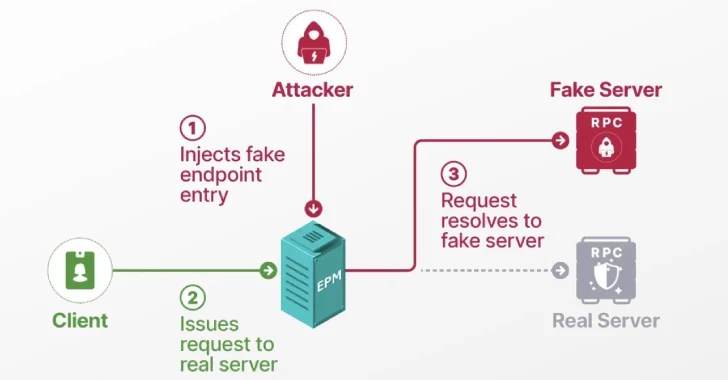
The vulnerability essentially makes it possible to manipulate a core component of the RPC protocol and stage what’s called an EPM poisoning attack that allows unprivileged users to pose as a legitimate, built-in service with the goal of coercing a protected process to authenticate against an arbitrary server of an attacker’s choosing.

Given that the functioning of EPM is analogous to that of the Domain Name System (DNS) – it maps an interface UUID to an endpoint, just the DNS resolves a domain to an IP address – the attack plays out like DNS poisoning, in which a threat actor tampers with DNS data to redirect users to malicious websites –

  • Poison the EPM
  • Masquerade as a legitimate RPC Server
  • Manipulate RPC clients
  • Achieve local/domain privilege escalation via an ESC8 attack

“I was shocked to discover that nothing stopped me from registering known, built-in interfaces that belong to core services,” Ben Yizhak said in a report shared with The Hacker News. “I expected, for example, if Windows Defender had a unique identifier, no other process would be able to register it. But that was not the case.”

Cybersecurity

“When I tried registering an interface of a service that was turned off, its client connected to me instead. This finding was unbelievable—there were no security checks completed by the EPM. It connected clients to an unknown process that wasn’t even running with admin privileges.”

The crux of the attack hinges on finding interfaces that aren’t mapped to an endpoint, as well as those that could be registered right after the system boots by taking advantage of the fact that many services are set to “delayed start” for performance reasons, and make the boot process faster.

In other words, any service with a manual startup is a security risk, as the RPC interface wouldn’t be registered on boot, effectively making it susceptible to a hijack by allowing an attacker to register an interface before the original service does.
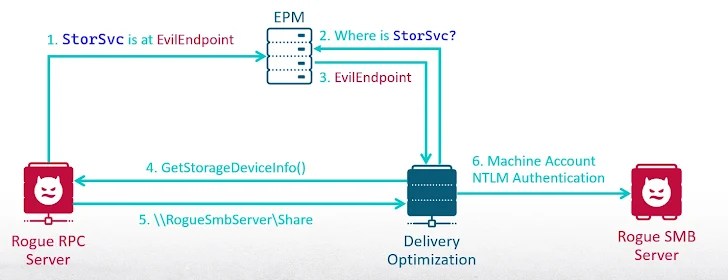
SafeBreach has also released a tool called RPC-Racer that can be used to flag insecure RPC services (e.g., the Storage Service or StorSvc.dll) and manipulate a Protected Process Light (PPL) process (e.g., the Delivery Optimization service or DoSvc.dll) to authenticate the machine account against any server selected by the attacker.

The PPL technology ensures that the operating system only loads trusted services and processes, and safeguards running processes from termination or infection by malicious code. It was introduced by Microsoft with the release of Windows 8.1.

At a high level, the entire attack sequence is as follows –

  • Create a scheduled task that will be executed when the current user logs in.
  • Register the interface of the Storage Service
  • Trigger the Delivery Optimization service to send an RPC request to the Storage Service, resulting in it connecting to the attacker’s dynamic endpoint
  • Call the method GetStorageDeviceInfo(), which causes the Delivery Optimization service to receive an SMB share to a rogue server set up by the attacker
  • The Delivery Optimization service authenticates with the malicious SMB server with the machine account credentials, leaking the NTLM hash
  • Stage an ESC8 attack to relay the coerced NTLM hashes to the web-based certificate enrollment services (AD CS) and achieve privilege escalation
Identity Security Risk Assessment

To accomplish this, an offensive open-source tool like Certipy can be used to request a Kerberos Ticket-Granting Ticket (TGT) using the certificate generated by passing the NTLM information to the AD CS server, and then leverage it to dump all secrets from the domain controller.

SafeBreach said the EPM poisoning technique could be further expanded to conduct adversary-in-the-middle (AitM) and denial-of-service (DoS) attacks by forwarding the requests to the original service or registering many interfaces and denying the requests, respectively. The cybersecurity company also pointed out that there could be other clients and interfaces that are likely vulnerable to EPM poisoning.

To better detect these kinds of attacks, security products can monitor calls to RpcEpRegister and use Event Tracing for Windows (ETW), a security feature that logs events that are raised by user-mode applications and kernel-mode drivers.

“Just like SSL pinning verifies that the certificate is not only valid but uses a specific public key, the identity of an RPC server should be checked,” Ben Yizhak said.

“The current design of the endpoint mapper (EPM) doesn’t perform this verification. Without this verification, clients will accept data from unknown sources. Trusting this data blindly allows an attacker to control the client’s actions and manipulate it to the attacker’s will.”

About The Author

[email protected] The Hacker News

See author's posts

Original post here

What do you feel about this?

  • The Hacker News

Post navigation

Previous: Linux-Based Lenovo Webcams’ Flaw Can Be Remotely Exploited for BadUSB Attacks
Next: New Win-DDoS Flaws Let Attackers Turn Public Domain Controllers into DDoS Botnet via RPC, LDAP

Author's Other Posts

Attackers Hijack MikroTik Routers Through Internet-Exposed SSH Without Authentication micro.jpg

Attackers Hijack MikroTik Routers Through Internet-Exposed SSH Without Authentication

September 6, 2026 0 0
Four REVSTEALER-Linked Modules Disable Windows Update and Defender to Run a Crypto Miner rev.jpg

Four REVSTEALER-Linked Modules Disable Windows Update and Defender to Run a Crypto Miner

September 6, 2026 0 0
Unpatched Magento and Adobe Commerce Zero-Day Exploited to Backdoor Online Stores adobe-exploit.jpg

Unpatched Magento and Adobe Commerce Zero-Day Exploited to Backdoor Online Stores

September 5, 2026 0 0
Attackers Breached JetBrains Cadence via Unpatched TeamCity, Extracting AWS Credentials jet.jpg

Attackers Breached JetBrains Cadence via Unpatched TeamCity, Extracting AWS Credentials

September 5, 2026 0 0

Related Stories

micro.jpg
  • The Hacker News

Attackers Hijack MikroTik Routers Through Internet-Exposed SSH Without Authentication

[email protected] The Hacker News September 6, 2026 0 0
rev.jpg
  • The Hacker News

Four REVSTEALER-Linked Modules Disable Windows Update and Defender to Run a Crypto Miner

[email protected] The Hacker News September 6, 2026 0 0
adobe-exploit.jpg
  • The Hacker News

Unpatched Magento and Adobe Commerce Zero-Day Exploited to Backdoor Online Stores

[email protected] The Hacker News September 5, 2026 0 0
jet.jpg
  • The Hacker News

Attackers Breached JetBrains Cadence via Unpatched TeamCity, Extracting AWS Credentials

[email protected] The Hacker News September 5, 2026 0 0
vmware-host.jpg
  • The Hacker News

Critical VMware Workstation and Fusion Flaw Lets VM Admins Execute Host Code

[email protected] The Hacker News September 5, 2026 0 0
trezor.jpg
  • The Hacker News

Trezor Says ShipMonk Breach Exposed 67,000 U.S. Customers’ Data It Said Was Deleted

[email protected] The Hacker News September 5, 2026 0 0

Trending Now

Attackers Hijack MikroTik Routers Through Internet-Exposed SSH Without Authentication micro.jpg 1

Attackers Hijack MikroTik Routers Through Internet-Exposed SSH Without Authentication

September 6, 2026 0 0
Four REVSTEALER-Linked Modules Disable Windows Update and Defender to Run a Crypto Miner rev.jpg 2

Four REVSTEALER-Linked Modules Disable Windows Update and Defender to Run a Crypto Miner

September 6, 2026 0 0
Unpatched Magento and Adobe Commerce Zero-Day Exploited to Backdoor Online Stores adobe-exploit.jpg 3

Unpatched Magento and Adobe Commerce Zero-Day Exploited to Backdoor Online Stores

September 5, 2026 0 0
Attackers Breached JetBrains Cadence via Unpatched TeamCity, Extracting AWS Credentials jet.jpg 4

Attackers Breached JetBrains Cadence via Unpatched TeamCity, Extracting AWS Credentials

September 5, 2026 0 0

Connect with Us

Social menu is not set. You need to create menu and assign it to Social Menu on Menu Settings.

Trending News

Attackers Hijack MikroTik Routers Through Internet-Exposed SSH Without Authentication micro.jpg 1
  • The Hacker News

Attackers Hijack MikroTik Routers Through Internet-Exposed SSH Without Authentication

September 6, 2026 0 0
Four REVSTEALER-Linked Modules Disable Windows Update and Defender to Run a Crypto Miner rev.jpg 2
  • The Hacker News

Four REVSTEALER-Linked Modules Disable Windows Update and Defender to Run a Crypto Miner

September 6, 2026 0 0
Unpatched Magento and Adobe Commerce Zero-Day Exploited to Backdoor Online Stores adobe-exploit.jpg 3
  • The Hacker News

Unpatched Magento and Adobe Commerce Zero-Day Exploited to Backdoor Online Stores

September 5, 2026 0 0
Attackers Breached JetBrains Cadence via Unpatched TeamCity, Extracting AWS Credentials jet.jpg 4
  • The Hacker News

Attackers Breached JetBrains Cadence via Unpatched TeamCity, Extracting AWS Credentials

September 5, 2026 0 0
Critical VMware Workstation and Fusion Flaw Lets VM Admins Execute Host Code vmware-host.jpg 5
  • The Hacker News

Critical VMware Workstation and Fusion Flaw Lets VM Admins Execute Host Code

September 5, 2026 0 0
Trezor Says ShipMonk Breach Exposed 67,000 U.S. Customers’ Data It Said Was Deleted trezor.jpg 6
  • The Hacker News

Trezor Says ShipMonk Breach Exposed 67,000 U.S. Customers’ Data It Said Was Deleted

September 5, 2026 0 0
Thousands of OpenAI Agents Quietly Turned an Abandoned Wiki Into Their Coordination Channel agents-openai.jpg 7
  • The Hacker News

Thousands of OpenAI Agents Quietly Turned an Abandoned Wiki Into Their Coordination Channel

September 5, 2026 0 0

You may have missed

micro.jpg
  • The Hacker News

Attackers Hijack MikroTik Routers Through Internet-Exposed SSH Without Authentication

[email protected] The Hacker News September 6, 2026 0 0
rev.jpg
  • The Hacker News

Four REVSTEALER-Linked Modules Disable Windows Update and Defender to Run a Crypto Miner

[email protected] The Hacker News September 6, 2026 0 0
adobe-exploit.jpg
  • The Hacker News

Unpatched Magento and Adobe Commerce Zero-Day Exploited to Backdoor Online Stores

[email protected] The Hacker News September 5, 2026 0 0
jet.jpg
  • The Hacker News

Attackers Breached JetBrains Cadence via Unpatched TeamCity, Extracting AWS Credentials

[email protected] The Hacker News September 5, 2026 0 0
Copyright © 2026 All rights reserved. | MoreNews by AF themes.