Skip to content

Secure IT

Stay Secure. Stay Informed.

Primary Menu
  • Home
  • Sources
    • Krebs On Security
    • Security Week
    • The Hacker News
    • Schneier On Security
  • Home
  • The Hacker News
  • Critical Flaws in Niagara Framework Threaten Smart Buildings and Industrial Systems Worldwide
  • The Hacker News

Critical Flaws in Niagara Framework Threaten Smart Buildings and Industrial Systems Worldwide

[email protected] The Hacker News Published: July 28, 2025 | Updated: July 28, 2025 4 min read
0 views

Cybersecurity researchers have discovered over a dozen security vulnerabilities impacting Tridium’s Niagara Framework that could allow an attacker on the same network to compromise the system under certain circumstances.

“These vulnerabilities are fully exploitable if a Niagara system is misconfigured, thereby disabling encryption on a specific network device,” Nozomi Networks Labs said in a report published last week. “If chained together, they could allow an attacker with access to the same network — such as through a Man-in-the-Middle (MiTM) position — to compromise the Niagara system.”

Developed by Tridium, an independent business entity of Honeywell, the Niagara Framework is a vendor-neutral platform used to manage and control a wide range of devices from different manufacturers, such as HVAC, lighting, energy management, and security, making it a valuable solution in building management, industrial automation, and smart infrastructure environments.

It consists of two key components: Platform, which is the underlying software environment that provides the necessary services to create, manage, and run Stations, and Station, which communicates with and controls connected devices and systems.

Cybersecurity

The vulnerabilities identified by Nozomi Networks are exploitable should a Niagara system be misconfigured, causing encryption to be disabled on a network device and opening the door to lateral movement and broader operational disruptions, impacting safety, productivity, and service continuity.

The most severe of the issues are listed below –

  • CVE-2025-3936 (CVSS score: 9.8) – Incorrect Permission Assignment for Critical Resource
  • CVE-2025-3937 (CVSS score: 9.8) – Use of Password Hash With Insufficient Computational Effort
  • CVE-2025-3938 (CVSS score: 9.8) – Missing Cryptographic Step
  • CVE-2025-3941 (CVSS score: 9.8) – Improper Handling of Windows: DATA Alternate Data Stream
  • CVE-2025-3944 (CVSS score: 9.8) – Incorrect Permission Assignment for Critical Resource
  • CVE-2025-3945 (CVSS score: 9.8) – Improper Neutralization of Argument Delimiters in a Command
  • CVE-2025-3943 (CVSS score: 7.3) – Use of GET Request Method With Sensitive Query Strings

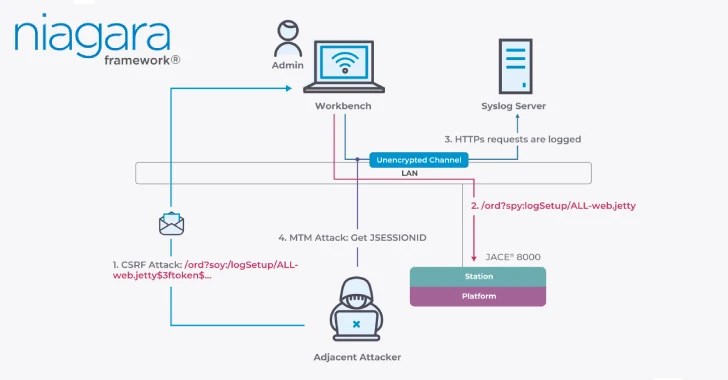
Nozomi Networks said it was able to craft an exploit chain combining CVE-2025-3943 and CVE-2025-3944 that could enable an adjacent attacker with access to the network to breach a Niagara-based target device, ultimately facilitating root-level remote code execution.

Specifically, the attacker could weaponize CVE-2025-3943 to intercept the anti-CSRF (cross-site request forgery) refresh token in scenarios where the Syslog service is enabled, causing the logs containing the token to be transmitted potentially over an unencrypted channel.

Armed with the token, the threat actor can trigger a CSRF attack and lure an administrator into visiting a specially crafted link that causes the content of all incoming HTTP requests and responses to be fully logged. The attacker then proceeds to extract the administrator’s JSESSIONID session token and use it to connect to the Niagara Station with full elevated permissions and creates a new backdoor administrator user for persistent access.

In the next stage of the attack, the administrative access is abused to download the private key associated with the device’s TLS certificate and conduct adversary-in-the-middle (AitM) attacks by taking advantage of the fact that both the Station and Platform share the same certificate and key infrastructure.

With control of the Platform, the attacker could leverage CVE-2025-3944 to facilitate root-level remote code execution on the device, achieving complete takeover. Following responsible disclosure, the issues have been addressed in Niagara Framework and Enterprise Security versions 4.14.2u2, 4.15.u1, or 4.10u.11.

“Because Niagara often connects critical systems and sometimes bridges IoT technology and information technology (IT) networks, it could represent a high-value target,” the company said.

“Given the critical functions that can be controlled by Niagara-powered systems, these vulnerabilities may pose a high risk to operational resilience and security provided the instance has not been configured per Tridium’s hardening guidelines and best practices.”

The disclosure comes as several memory corruption flaws have been discovered in the P-Net C library, an open-source implementation of the PROFINET protocol for IO devices, that, if successfully exploited, could allow unauthenticated attackers with network access to the targeted device to trigger denial-of-service (DoS) conditions.

“Practically speaking, exploiting CVE-2025-32399, an attacker can force the CPU running the P-Net library into an infinite loop, consuming 100% CPU resources,” Nozomi Networks said. “Another vulnerability, tracked as CVE-2025-32405, allows an attacker to write beyond the boundaries of a connection buffer, corrupting memory and making the device entirely unusable.”

Cybersecurity

The vulnerabilities have been resolved in version 1.0.2 of the library, which was released in late April 2025.

In recent months, several security defects have also been unearthed in Rockwell Automation PowerMonitor 1000, Bosch Rexroth ctrlX CORE, and Inaba Denki Sangyo’s IB-MCT001 cameras that could result in execution of arbitrary commands, device takeover, DoS, information theft, and even remotely access live footage for surveillance.

“Successful exploitation of these vulnerabilities could allow an attacker to obtain the product’s login password, gain unauthorized access, tamper with product’s data, and/or modify product settings,” the U.S. Cybersecurity and Infrastructure Security Agency (CISA) said in an advisory for IB-MCT001 flaws.

About The Author

[email protected] The Hacker News

See author's posts

Original post here

What do you feel about this?

  • The Hacker News

Post navigation

Previous: U.S. Sanctions Firm Behind N. Korean IT Scheme; Arizona Woman Jailed for Running Laptop Farm
Next: Scattered Spider Hijacks VMware ESXi to Deploy Ransomware on Critical U.S. Infrastructure

Author's Other Posts

India Orders Messaging Apps to Work Only With Active SIM Cards to Prevent Fraud and Misuse whatsapp-sim.jpg

India Orders Messaging Apps to Work Only With Active SIM Cards to Prevent Fraud and Misuse

December 2, 2025 0 0
Researchers Capture Lazarus APT’s Remote-Worker Scheme Live on Camera korean.jpg

Researchers Capture Lazarus APT’s Remote-Worker Scheme Live on Camera

December 2, 2025 0 1
GlassWorm Returns with 24 Malicious Extensions Impersonating Popular Developer Tools hacked.jpg

GlassWorm Returns with 24 Malicious Extensions Impersonating Popular Developer Tools

December 2, 2025 0 0
Malicious npm Package Uses Hidden Prompt and Script to Evade AI Security Tools npm-mal.jpg

Malicious npm Package Uses Hidden Prompt and Script to Evade AI Security Tools

December 2, 2025 0 1

Related Stories

whatsapp-sim.jpg
  • The Hacker News

India Orders Messaging Apps to Work Only With Active SIM Cards to Prevent Fraud and Misuse

[email protected] The Hacker News December 2, 2025 0 0
korean.jpg
  • The Hacker News

Researchers Capture Lazarus APT’s Remote-Worker Scheme Live on Camera

[email protected] The Hacker News December 2, 2025 0 1
hacked.jpg
  • The Hacker News

GlassWorm Returns with 24 Malicious Extensions Impersonating Popular Developer Tools

[email protected] The Hacker News December 2, 2025 0 0
npm-mal.jpg
  • The Hacker News

Malicious npm Package Uses Hidden Prompt and Script to Evade AI Security Tools

[email protected] The Hacker News December 2, 2025 0 1
iran-hacking.jpg
  • The Hacker News

Iran-Linked Hackers Hits Israeli Sectors with New MuddyViper Backdoor in Targeted Attacks

[email protected] The Hacker News December 2, 2025 0 0
SecAlerts.jpg
  • The Hacker News

SecAlerts Cuts Through the Noise with a Smarter, Faster Way to Track Vulnerabilities

[email protected] The Hacker News December 2, 2025 0 0

Trending Now

Drones to Diplomas: How Russia’s Largest Private University is Linked to a $25M Essay Mill Drones to Diplomas: How Russia’s Largest Private University is Linked to a $25M Essay Mill 1

Drones to Diplomas: How Russia’s Largest Private University is Linked to a $25M Essay Mill

December 6, 2025 0 0
SMS Phishers Pivot to Points, Taxes, Fake Retailers SMS Phishers Pivot to Points, Taxes, Fake Retailers 2

SMS Phishers Pivot to Points, Taxes, Fake Retailers

December 4, 2025 0 0
India Orders Messaging Apps to Work Only With Active SIM Cards to Prevent Fraud and Misuse whatsapp-sim.jpg 3

India Orders Messaging Apps to Work Only With Active SIM Cards to Prevent Fraud and Misuse

December 2, 2025 0 0
Researchers Capture Lazarus APT’s Remote-Worker Scheme Live on Camera korean.jpg 4

Researchers Capture Lazarus APT’s Remote-Worker Scheme Live on Camera

December 2, 2025 0 1

Connect with Us

Social menu is not set. You need to create menu and assign it to Social Menu on Menu Settings.

Trending News

Drones to Diplomas: How Russia’s Largest Private University is Linked to a $25M Essay Mill Drones to Diplomas: How Russia’s Largest Private University is Linked to a $25M Essay Mill 1
  • Uncategorized

Drones to Diplomas: How Russia’s Largest Private University is Linked to a $25M Essay Mill

December 6, 2025 0 0
SMS Phishers Pivot to Points, Taxes, Fake Retailers SMS Phishers Pivot to Points, Taxes, Fake Retailers 2
  • Uncategorized

SMS Phishers Pivot to Points, Taxes, Fake Retailers

December 4, 2025 0 0
India Orders Messaging Apps to Work Only With Active SIM Cards to Prevent Fraud and Misuse whatsapp-sim.jpg 3
  • The Hacker News

India Orders Messaging Apps to Work Only With Active SIM Cards to Prevent Fraud and Misuse

December 2, 2025 0 0
Researchers Capture Lazarus APT’s Remote-Worker Scheme Live on Camera korean.jpg 4
  • The Hacker News

Researchers Capture Lazarus APT’s Remote-Worker Scheme Live on Camera

December 2, 2025 0 1
GlassWorm Returns with 24 Malicious Extensions Impersonating Popular Developer Tools hacked.jpg 5
  • The Hacker News

GlassWorm Returns with 24 Malicious Extensions Impersonating Popular Developer Tools

December 2, 2025 0 0
Malicious npm Package Uses Hidden Prompt and Script to Evade AI Security Tools npm-mal.jpg 6
  • The Hacker News

Malicious npm Package Uses Hidden Prompt and Script to Evade AI Security Tools

December 2, 2025 0 1
Iran-Linked Hackers Hits Israeli Sectors with New MuddyViper Backdoor in Targeted Attacks iran-hacking.jpg 7
  • The Hacker News

Iran-Linked Hackers Hits Israeli Sectors with New MuddyViper Backdoor in Targeted Attacks

December 2, 2025 0 0

You may have missed

Drones to Diplomas: How Russia’s Largest Private University is Linked to a $25M Essay Mill
  • Uncategorized

Drones to Diplomas: How Russia’s Largest Private University is Linked to a $25M Essay Mill

Sean December 6, 2025 0 0
SMS Phishers Pivot to Points, Taxes, Fake Retailers
  • Uncategorized

SMS Phishers Pivot to Points, Taxes, Fake Retailers

Sean December 4, 2025 0 0
whatsapp-sim.jpg
  • The Hacker News

India Orders Messaging Apps to Work Only With Active SIM Cards to Prevent Fraud and Misuse

[email protected] The Hacker News December 2, 2025 0 0
korean.jpg
  • The Hacker News

Researchers Capture Lazarus APT’s Remote-Worker Scheme Live on Camera

[email protected] The Hacker News December 2, 2025 0 1
Copyright © 2026 All rights reserved. | MoreNews by AF themes.