Skip to content

Secure IT

Stay Secure. Stay Informed.

Primary Menu
  • Home
  • Sources
    • Krebs On Security
    • Security Week
    • The Hacker News
    • Schneier On Security
  • Home
  • The Hacker News
  • New Atomic macOS Stealer Campaign Exploits ClickFix to Target Apple Users
  • The Hacker News

New Atomic macOS Stealer Campaign Exploits ClickFix to Target Apple Users

[email protected] The Hacker News Published: June 6, 2025 | Updated: June 6, 2025 4 min read
2 views
New Atomic macOS Stealer Campaign

Cybersecurity researchers are alerting to a new malware campaign that employs the ClickFix social engineering tactic to trick users into downloading an information stealer malware known as Atomic macOS Stealer (AMOS) on Apple macOS systems.

The campaign, according to CloudSEK, has been found to leverage typosquat domains mimicking U.S.-based telecom provider Spectrum.

“macOS users are served a malicious shell script designed to steal system passwords and download an AMOS variant for further exploitation,” security researcher Koushik Pal said in a report published this week. “The script uses native macOS commands to harvest credentials, bypass security mechanisms, and execute malicious binaries.”

It’s believed that the activity is the work of Russian-speaking cybercriminals owing to the presence of Russian language comments in the malware’s source code.

Cybersecurity

The starting point of the attack is a web page that impersonates Spectrum (“panel-spectrum[.]net” or “spectrum-ticket[.]net”). Visitors to the sites in question are served a message that instructs them to complete a hCaptcha verification check to in order to “review the security” of their connection before proceeding further.

However, when the user clicks the “I am human” checkbox for evaluation, they are displayed an error message stating “CAPTCHA verification failed,” urging them to click a button to go ahead with an “Alternative Verification.”

Doing so causes a command to be copied to the users’ clipboard and the victim is shown a set of instructions depending on their operating system. While they are guided to run a PowerShell command on Windows by opening the Windows Run dialog, it’s substituted by a shell script that’s executed by launching the Terminal app on macOS.

The shell script, for its part, prompts users to enter their system password and downloads a next-stage payload, in this case, a known stealer called Atomic Stealer.

“Poorly implemented logic in the delivery sites, such as mismatched instructions across platforms, points to hastily assembled infrastructure,” Pal said.

“The delivery pages in question for this AMOS variant campaign contained inaccuracies in both its programming and front-end logic. For Linux user agents, a PowerShell command was copied. Furthermore, the instruction ‘Press & hold the Windows Key + R’ was displayed to both Windows and Mac users.”

The disclosure comes amid a surge in campaigns using the ClickFix tactic to deliver a wide range of malware families over the past year.

“Actors carrying out these targeted attacks typically utilize similar techniques, tools, and procedures (TTPs) to gain initial access,” Darktrace said. “These include spear phishing attacks, drive-by compromises, or exploiting trust in familiar online platforms, such as GitHub, to deliver malicious payloads.”
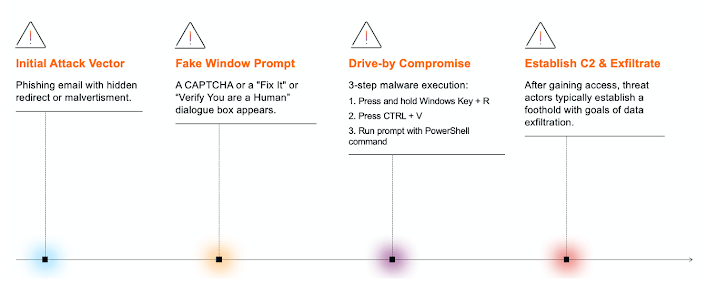
The links distributed using these vectors typically redirect the end user to a malicious URL that displays a fake CAPTCHA verification check and completes it in an attempt to deceive users into thinking that they are carrying out something innocuous, when, in reality, they are guided to execute malicious commands to fix a non-existent issue.

The end result of this effective social engineering method is that users end up compromising their own systems, effectively bypassing security controls.

In one April 2025 incident analyzed by Darktrace, unknown threat actors were found to utilize ClickFix as an attack vector to download nondescript payloads to burrow deeper into the target environment, conduct lateral movement, send system-related information to an external server via an HTTP POST request, and ultimately exfiltrate data.

“ClickFix baiting is a widely used tactic in which threat actors exploit human error to bypass security defenses,” Darktrace said. “By tricking endpoint users into performing seemingly harmless, everyday actions, attackers gain initial access to systems where they can access and exfiltrate sensitive data.”

Cybersecurity

Other ClickFix attacks have employed phony versions of other popular CAPTCHA services like Google reCAPTCHA and Cloudflare Turnstile for malware delivery under the guise of routine security checks.

These fake pages are “pixel-perfect copies” of their legitimate counterparts, sometimes even injected into real-but-hacked websites to trick unsuspecting users. Stealers such as Lumma and StealC, as well as full-fledged remote access trojans (RATs) like NetSupport RAT are some of the payloads distributed via bogus Turnstile pages.

“Modern internet users are inundated with spam checks, CAPTCHAs, and security prompts on websites, and they’ve been conditioned to click through these as quickly as possible,” SlashNext’s Daniel Kelley said. “Attackers exploit this ‘verification fatigue,’ knowing that many users will comply with whatever steps are presented if it looks routine.”

Found this article interesting? This article is a contributed piece from one of our valued partners. Follow us on Twitter  and LinkedIn to read more exclusive content we post.

About The Author

[email protected] The Hacker News

See author's posts

Original post here

What do you feel about this?

  • The Hacker News

Post navigation

Previous: Empower Users and Protect Against GenAI Data Loss
Next: Malicious Browser Extensions Infect 722 Users Across Latin America Since Early 2025

Author's Other Posts

Attackers Hijack MikroTik Routers Through Internet-Exposed SSH Without Authentication micro.jpg

Attackers Hijack MikroTik Routers Through Internet-Exposed SSH Without Authentication

September 6, 2026 0 0
Four REVSTEALER-Linked Modules Disable Windows Update and Defender to Run a Crypto Miner rev.jpg

Four REVSTEALER-Linked Modules Disable Windows Update and Defender to Run a Crypto Miner

September 6, 2026 0 0
Unpatched Magento and Adobe Commerce Zero-Day Exploited to Backdoor Online Stores adobe-exploit.jpg

Unpatched Magento and Adobe Commerce Zero-Day Exploited to Backdoor Online Stores

September 5, 2026 0 0
Attackers Breached JetBrains Cadence via Unpatched TeamCity, Extracting AWS Credentials jet.jpg

Attackers Breached JetBrains Cadence via Unpatched TeamCity, Extracting AWS Credentials

September 5, 2026 0 0

Related Stories

micro.jpg
  • The Hacker News

Attackers Hijack MikroTik Routers Through Internet-Exposed SSH Without Authentication

[email protected] The Hacker News September 6, 2026 0 0
rev.jpg
  • The Hacker News

Four REVSTEALER-Linked Modules Disable Windows Update and Defender to Run a Crypto Miner

[email protected] The Hacker News September 6, 2026 0 0
adobe-exploit.jpg
  • The Hacker News

Unpatched Magento and Adobe Commerce Zero-Day Exploited to Backdoor Online Stores

[email protected] The Hacker News September 5, 2026 0 0
jet.jpg
  • The Hacker News

Attackers Breached JetBrains Cadence via Unpatched TeamCity, Extracting AWS Credentials

[email protected] The Hacker News September 5, 2026 0 0
vmware-host.jpg
  • The Hacker News

Critical VMware Workstation and Fusion Flaw Lets VM Admins Execute Host Code

[email protected] The Hacker News September 5, 2026 0 0
trezor.jpg
  • The Hacker News

Trezor Says ShipMonk Breach Exposed 67,000 U.S. Customers’ Data It Said Was Deleted

[email protected] The Hacker News September 5, 2026 0 0

Trending Now

Attackers Hijack MikroTik Routers Through Internet-Exposed SSH Without Authentication micro.jpg 1

Attackers Hijack MikroTik Routers Through Internet-Exposed SSH Without Authentication

September 6, 2026 0 0
Four REVSTEALER-Linked Modules Disable Windows Update and Defender to Run a Crypto Miner rev.jpg 2

Four REVSTEALER-Linked Modules Disable Windows Update and Defender to Run a Crypto Miner

September 6, 2026 0 0
Unpatched Magento and Adobe Commerce Zero-Day Exploited to Backdoor Online Stores adobe-exploit.jpg 3

Unpatched Magento and Adobe Commerce Zero-Day Exploited to Backdoor Online Stores

September 5, 2026 0 0
Attackers Breached JetBrains Cadence via Unpatched TeamCity, Extracting AWS Credentials jet.jpg 4

Attackers Breached JetBrains Cadence via Unpatched TeamCity, Extracting AWS Credentials

September 5, 2026 0 0

Connect with Us

Social menu is not set. You need to create menu and assign it to Social Menu on Menu Settings.

Trending News

Attackers Hijack MikroTik Routers Through Internet-Exposed SSH Without Authentication micro.jpg 1
  • The Hacker News

Attackers Hijack MikroTik Routers Through Internet-Exposed SSH Without Authentication

September 6, 2026 0 0
Four REVSTEALER-Linked Modules Disable Windows Update and Defender to Run a Crypto Miner rev.jpg 2
  • The Hacker News

Four REVSTEALER-Linked Modules Disable Windows Update and Defender to Run a Crypto Miner

September 6, 2026 0 0
Unpatched Magento and Adobe Commerce Zero-Day Exploited to Backdoor Online Stores adobe-exploit.jpg 3
  • The Hacker News

Unpatched Magento and Adobe Commerce Zero-Day Exploited to Backdoor Online Stores

September 5, 2026 0 0
Attackers Breached JetBrains Cadence via Unpatched TeamCity, Extracting AWS Credentials jet.jpg 4
  • The Hacker News

Attackers Breached JetBrains Cadence via Unpatched TeamCity, Extracting AWS Credentials

September 5, 2026 0 0
Critical VMware Workstation and Fusion Flaw Lets VM Admins Execute Host Code vmware-host.jpg 5
  • The Hacker News

Critical VMware Workstation and Fusion Flaw Lets VM Admins Execute Host Code

September 5, 2026 0 0
Trezor Says ShipMonk Breach Exposed 67,000 U.S. Customers’ Data It Said Was Deleted trezor.jpg 6
  • The Hacker News

Trezor Says ShipMonk Breach Exposed 67,000 U.S. Customers’ Data It Said Was Deleted

September 5, 2026 0 0
Thousands of OpenAI Agents Quietly Turned an Abandoned Wiki Into Their Coordination Channel agents-openai.jpg 7
  • The Hacker News

Thousands of OpenAI Agents Quietly Turned an Abandoned Wiki Into Their Coordination Channel

September 5, 2026 0 0

You may have missed

micro.jpg
  • The Hacker News

Attackers Hijack MikroTik Routers Through Internet-Exposed SSH Without Authentication

[email protected] The Hacker News September 6, 2026 0 0
rev.jpg
  • The Hacker News

Four REVSTEALER-Linked Modules Disable Windows Update and Defender to Run a Crypto Miner

[email protected] The Hacker News September 6, 2026 0 0
adobe-exploit.jpg
  • The Hacker News

Unpatched Magento and Adobe Commerce Zero-Day Exploited to Backdoor Online Stores

[email protected] The Hacker News September 5, 2026 0 0
jet.jpg
  • The Hacker News

Attackers Breached JetBrains Cadence via Unpatched TeamCity, Extracting AWS Credentials

[email protected] The Hacker News September 5, 2026 0 0
Copyright © 2026 All rights reserved. | MoreNews by AF themes.