Skip to content

Secure IT

Stay Secure. Stay Informed.

Primary Menu
  • Home
  • Sources
    • Krebs On Security
    • Security Week
    • The Hacker News
    • Schneier On Security
  • Home
  • The Hacker News
  • Hazy Hawk Exploits DNS Records to Hijack CDC, Corporate Domains for Malware Delivery
  • The Hacker News

Hazy Hawk Exploits DNS Records to Hijack CDC, Corporate Domains for Malware Delivery

[email protected] The Hacker News Published: May 20, 2025 | Updated: May 20, 2025 3 min read
1 views

May 20, 2025Ravie LakshmananMalware / Cloud Security

A threat actor known as Hazy Hawk has been observed hijacking abandoned cloud resources of high-profile organizations, including Amazon S3 buckets and Microsoft Azure endpoints, by leveraging misconfigurations in the Domain Name System (DNS) records.

The hijacked domains are then used to host URLs that direct users to scams and malware via traffic distribution systems (TDSes), according to Infoblox. Some of the other resources usurped by the threat actor include those hosted on Akamai, Bunny CDN, Cloudflare CDN, GitHub, and Netlify.

The DNS threat intelligence firm said it first discovered the threat actor after it gained control of several sub-domains associated with the U.S. Center for Disease Control (CDC) in February 2025.

It has since been determined that other government agencies across the globe, prominent universities, and international corporations such as Deloitte, PricewaterhouseCoopers, and Ernst & Young have been victimized by the same threat actor since at least December 2023.

Cybersecurity

“Perhaps the most remarkable thing about Hazy Hawk is that these hard-to-discover, vulnerable domains with ties to esteemed organizations are not being used for espionage or ‘highbrow’ cybercrime,” Infoblox’s Jacques Portal and Renée Burton said in a report shared with The Hacker News.

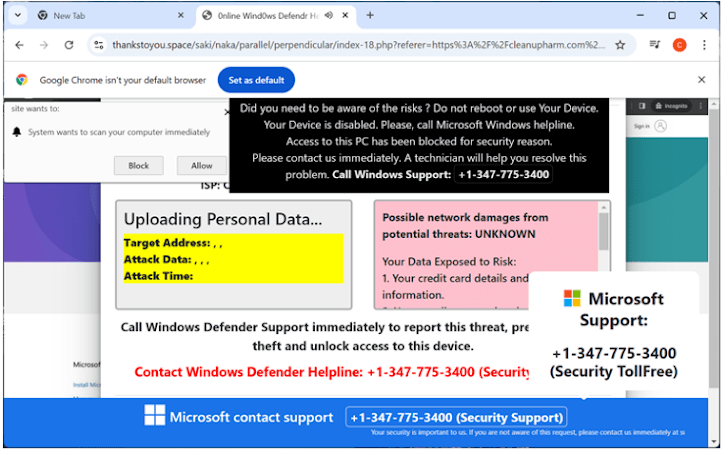
“Instead, they feed into the seedy underworld of adtech, whisking victims to a wide range of scams and fake applications, and using browser notifications to trigger processes that will have a lingering impact.”

What makes Hazy Hawk’s operations noteworthy is the hijacking of trusted and reputable domains belonging to legitimate organizations, thus boosting their credibility in search results when they are being used to serve malicious and spammy content. But even more concerningly, the approach enables the threat actors to bypass detection.

Underpinning the operation is the ability of the attackers to seize control of abandoned domains with dangling DNS CNAME records, a technique previously exposed by Guardio in early 2024 as being exploited by bad actors for spam proliferation and click monetization. All a threat actor needs to do is register the missing resource to hijack the domain.
The Hacker News

Hazy Hawk goes a step further by finding abandoned cloud resources and then commandeering them for malicious purposes. In some cases, the threat actor employs URL redirection techniques to conceal which cloud resource was hijacked.

“We use the name Hazy Hawk for this actor because of how they find and hijack cloud resources that have dangling DNS CNAME records and then use them in malicious URL distribution,” Infoblox said. “It’s possible that the domain hijacking component is provided as a service and is used by a group of actors.”

The attack chains often involve cloning the content of legitimate sites for their initial site hosted on the hijacked domains, while luring victims into visiting them with pornographic or pirated content. The site visitors are then funneled via a TDS to determine where they land next.

Cybersecurity

“Hazy Hawk is one of the dozens of threat actors we track within the advertising affiliate world,” the company said. “Threat actors who belong to affiliate advertising programs drive users into tailored malicious content and are incentivized to include requests to allow push notifications from ‘websites’ along the redirection path.”

In doing so, the idea is to flood a victim’s device with push notifications and deliver an endless torrent of malicious content, with each notification leading to different scams, scareware, and fake surveys, and accompanied by requests to allow more push notifications.

To prevent and protect against Hazy Hawk activities, domain owners are recommended to remove a DNS CNAME record as soon as a resource is shut down. End users, on the other hand, are advised to deny notification requests from websites they don’t know.

“While operators like Hazy Hawk are responsible for the initial lure, the user who clicks is led into a labyrinth of sketchy and outright malicious adtech. The fact that Hazy Hawk puts considerable effort into locating vulnerable domains and then using them for scam operations shows that these advertising affiliate programs are successful enough to pay well,” Infoblox said.

Found this article interesting? Follow us on Twitter  and LinkedIn to read more exclusive content we post.

About The Author

[email protected] The Hacker News

See author's posts

Original post here

What do you feel about this?

  • The Hacker News

Post navigation

Previous: 100+ Fake Chrome Extensions Found Hijacking Sessions, Stealing Credentials, Injecting Ads
Next: KrebsOnSecurity Hit With Near-Record 6.3 Tbps DDoS

Author's Other Posts

Attackers Hijack MikroTik Routers Through Internet-Exposed SSH Without Authentication micro.jpg

Attackers Hijack MikroTik Routers Through Internet-Exposed SSH Without Authentication

September 6, 2026 0 0
Four REVSTEALER-Linked Modules Disable Windows Update and Defender to Run a Crypto Miner rev.jpg

Four REVSTEALER-Linked Modules Disable Windows Update and Defender to Run a Crypto Miner

September 6, 2026 0 0
Unpatched Magento and Adobe Commerce Zero-Day Exploited to Backdoor Online Stores adobe-exploit.jpg

Unpatched Magento and Adobe Commerce Zero-Day Exploited to Backdoor Online Stores

September 5, 2026 0 0
Attackers Breached JetBrains Cadence via Unpatched TeamCity, Extracting AWS Credentials jet.jpg

Attackers Breached JetBrains Cadence via Unpatched TeamCity, Extracting AWS Credentials

September 5, 2026 0 0

Related Stories

micro.jpg
  • The Hacker News

Attackers Hijack MikroTik Routers Through Internet-Exposed SSH Without Authentication

[email protected] The Hacker News September 6, 2026 0 0
rev.jpg
  • The Hacker News

Four REVSTEALER-Linked Modules Disable Windows Update and Defender to Run a Crypto Miner

[email protected] The Hacker News September 6, 2026 0 0
adobe-exploit.jpg
  • The Hacker News

Unpatched Magento and Adobe Commerce Zero-Day Exploited to Backdoor Online Stores

[email protected] The Hacker News September 5, 2026 0 0
jet.jpg
  • The Hacker News

Attackers Breached JetBrains Cadence via Unpatched TeamCity, Extracting AWS Credentials

[email protected] The Hacker News September 5, 2026 0 0
vmware-host.jpg
  • The Hacker News

Critical VMware Workstation and Fusion Flaw Lets VM Admins Execute Host Code

[email protected] The Hacker News September 5, 2026 0 0
trezor.jpg
  • The Hacker News

Trezor Says ShipMonk Breach Exposed 67,000 U.S. Customers’ Data It Said Was Deleted

[email protected] The Hacker News September 5, 2026 0 0

Trending Now

Attackers Hijack MikroTik Routers Through Internet-Exposed SSH Without Authentication micro.jpg 1

Attackers Hijack MikroTik Routers Through Internet-Exposed SSH Without Authentication

September 6, 2026 0 0
Four REVSTEALER-Linked Modules Disable Windows Update and Defender to Run a Crypto Miner rev.jpg 2

Four REVSTEALER-Linked Modules Disable Windows Update and Defender to Run a Crypto Miner

September 6, 2026 0 0
Unpatched Magento and Adobe Commerce Zero-Day Exploited to Backdoor Online Stores adobe-exploit.jpg 3

Unpatched Magento and Adobe Commerce Zero-Day Exploited to Backdoor Online Stores

September 5, 2026 0 0
Attackers Breached JetBrains Cadence via Unpatched TeamCity, Extracting AWS Credentials jet.jpg 4

Attackers Breached JetBrains Cadence via Unpatched TeamCity, Extracting AWS Credentials

September 5, 2026 0 0

Connect with Us

Social menu is not set. You need to create menu and assign it to Social Menu on Menu Settings.

Trending News

Attackers Hijack MikroTik Routers Through Internet-Exposed SSH Without Authentication micro.jpg 1
  • The Hacker News

Attackers Hijack MikroTik Routers Through Internet-Exposed SSH Without Authentication

September 6, 2026 0 0
Four REVSTEALER-Linked Modules Disable Windows Update and Defender to Run a Crypto Miner rev.jpg 2
  • The Hacker News

Four REVSTEALER-Linked Modules Disable Windows Update and Defender to Run a Crypto Miner

September 6, 2026 0 0
Unpatched Magento and Adobe Commerce Zero-Day Exploited to Backdoor Online Stores adobe-exploit.jpg 3
  • The Hacker News

Unpatched Magento and Adobe Commerce Zero-Day Exploited to Backdoor Online Stores

September 5, 2026 0 0
Attackers Breached JetBrains Cadence via Unpatched TeamCity, Extracting AWS Credentials jet.jpg 4
  • The Hacker News

Attackers Breached JetBrains Cadence via Unpatched TeamCity, Extracting AWS Credentials

September 5, 2026 0 0
Critical VMware Workstation and Fusion Flaw Lets VM Admins Execute Host Code vmware-host.jpg 5
  • The Hacker News

Critical VMware Workstation and Fusion Flaw Lets VM Admins Execute Host Code

September 5, 2026 0 0
Trezor Says ShipMonk Breach Exposed 67,000 U.S. Customers’ Data It Said Was Deleted trezor.jpg 6
  • The Hacker News

Trezor Says ShipMonk Breach Exposed 67,000 U.S. Customers’ Data It Said Was Deleted

September 5, 2026 0 0
Thousands of OpenAI Agents Quietly Turned an Abandoned Wiki Into Their Coordination Channel agents-openai.jpg 7
  • The Hacker News

Thousands of OpenAI Agents Quietly Turned an Abandoned Wiki Into Their Coordination Channel

September 5, 2026 0 0

You may have missed

micro.jpg
  • The Hacker News

Attackers Hijack MikroTik Routers Through Internet-Exposed SSH Without Authentication

[email protected] The Hacker News September 6, 2026 0 0
rev.jpg
  • The Hacker News

Four REVSTEALER-Linked Modules Disable Windows Update and Defender to Run a Crypto Miner

[email protected] The Hacker News September 6, 2026 0 0
adobe-exploit.jpg
  • The Hacker News

Unpatched Magento and Adobe Commerce Zero-Day Exploited to Backdoor Online Stores

[email protected] The Hacker News September 5, 2026 0 0
jet.jpg
  • The Hacker News

Attackers Breached JetBrains Cadence via Unpatched TeamCity, Extracting AWS Credentials

[email protected] The Hacker News September 5, 2026 0 0
Copyright © 2026 All rights reserved. | MoreNews by AF themes.