
The North Korea-linked threat actor known as Konni APT has been attributed to a phishing campaign targeting government entities in Ukraine, indicating the threat actor’s targeting beyond Russia.
Enterprise security firm Proofpoint said the end goal of the campaign is to collect intelligence on the “trajectory of the Russian invasion.”
“The group’s interest in Ukraine follows historical targeting of government entities in Russia for strategic intelligence gathering purposes,” security researchers Greg Lesnewich, Saher Naumaan, and Mark Kelly said in a report shared with The Hacker News.
Konni APT, also known as Opal Sleet, Osmium, TA406, and Vedalia, is a cyber espionage group that has a history of targeting entities in South Korea, the United States, and Russia. It’s operational since at least 2014.
Attack chains mounted by the threat actor often involve the use of phishing emails to distribute malware called Konni RAT (aka UpDog) and redirect recipients to credential harvesting pages. Proofpoint, in an analysis of the threat group published in November 2021, assessed TA406 to be one of several actors that make up the activity publicly tracked as Kimsuky, Thallium, and Konni Group.
The latest set of attacks documented by the cybersecurity company entails the use of phishing emails that impersonate a fictitious senior fellow at a think tank called the Royal Institute of Strategic Studies, which is also a non-existent organization.
The email messages contain a link to a password-protected RAR archive that’s hosted on the MEGA cloud service. Opening the RAR archive using a password mentioned in the message body launches an infection sequence that’s engineered to conduct extensive reconnaissance of the compromised machines.

Specifically, present within the RAR archive is a CHM file that displays decoy content related to former Ukrainian military leader Valeriy Zaluzhnyi. Should the victim click anywhere on the page, a PowerShell command embedded within the HTML is executed to reach out to an external server and download a next-stage PowerShell payload.
The newly launched PowerShell script is capable of executing various commands to gather information about the system, encode it using Base64-encoding, and send it to the same server.
“The actor sent multiple phishing emails on consecutive days when the target did not click the link, asking the target if they had received the prior emails and if they would download the files,” the researchers said.
Proofpoint said it also observed an HTML file being directly distributed as an attachment to the phishing messages. In this variation of the attack, the victim is instructed to click on an embedded link in the HTML file, resulting in the download of a ZIP archive that includes a benign PDF and a Windows shortcut (LNK) file.
When the LNK is run, it executes Base64-encoded PowerShell to drop a Javascript Encoded file called “Themes.jse” using a Visual Basic Script. The JSE malware, in turn, contacts an attacker-controlled URL and runs the response from the server via PowerShell. The exact nature of the payload is currently not known.
Furthermore, TA406 has been spotted attempting to harvest credentials by sending fake Microsoft security alert messages to Ukrainian government entities from ProtonMail accounts, warning them of suspicious sign-in activity from IP addresses located in the United States and urging them to verify the login by visiting a link.
While the credential harvesting page has not been recovered, the same compromised domain is said to have been used in the past to collect Naver login information.
“These credential harvesting campaigns took place prior to the attempted malware deployments and targeted some of the same users later targeted with the HTML delivery campaign,” Proofpoint said. “TA406 is very likely gathering intelligence to help North Korean leadership determine the current risk to its forces already in the theatre, as well as the likelihood that Russia will request more troops or armaments.”
“Unlike Russian groups who have likely been tasked with gathering tactical battlefield information and targeting of Ukrainian forces in situ, TA406 has typically focused on more strategic, political intelligence collection efforts.”
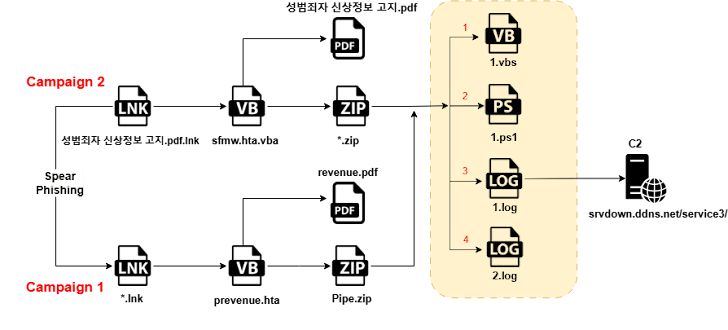
The disclosure comes as the Konni group has been linked to a sophisticated multi-stage malware campaign targeting entities in South Korea with ZIP archives containing LNK files, which run PowerShell scripts to extract a CAB archive and ultimately deliver batch script malware capable of collecting sensitive data and exfiltrating it to a remote server.
The findings also dovetail with spear-phishing campaigns orchestrated by Kimsuky to target government agencies in South Korea by delivering a stealer malware capable of establishing command-and-control (C2 or C&C) communications and exfiltrating files, web browser data, and cryptocurrency wallet information.

According to South Korean cybersecurity company AhnLab, Kimsuky has also been observed propagating PEBBLEDASH as part of a multi-stage infection sequence initiated via spear-phishing. The trojan was attributed by the U.S. government to the Lazarus Group in May 2020.
“While the Kimsuky group uses various types of malware, in the case of PEBBLEDASH, they execute malware based on an LNK file by spear-phishing in the initial access stage to launch their attacks,” it said.

“They then utilize a PowerShell script to create a task scheduler and register it for automatic execution. Through communication with a Dropbox and TCP socket-based C&C server, the group installs multiple malware and tools including PEBBLEDASH.”
Konni and Kimsuky are far from the only North Korean threat actors to focus on Seoul. As recently as March 2025, South Korean entities have been found to be at the receiving end of another campaign carried out by APT37, which is also referred to as ScarCruft.
Dubbed Operation ToyBox Story, the spear-phishing attacks singled out several activists focused on North Korea, per the Genians Security Center (GSC). The first observed spear phishing attack occurred on March 8, 2025.
“The email contained a Dropbox link leading to a compressed archive that included a malicious shortcut (LNK) file,” the South Korean company said. “When extracted and executed, the LNK file activated additional malware containing the keyword ‘toy.'”

The LNK files are configured to launch a decoy HWP file and run PowerShell commands, leading to the execution of files named toy03.bat, toy02.bat, and toy01.bat (in that order), the last of which contains shellcode to launch RoKRAT, a staple malware associated with APT37.
RokRAT is equipped to collect system information, capture screenshots, and use three different cloud services, including pCloud, Yandex, and Dropbox for C2.
“The threat actors exploited legitimate cloud services as C2 infrastructure and continued to modify shortcut (LNK) files while focusing on fileless attack techniques to evade detection by antivirus software installed on target endpoints,” Genians said.
About The Author

Original post here


